
The new physics
of go-to-market
in an AI-first world
How companies rebuild go-to-market after product-market fit.
by Jared Waxman
GTM Engineer School · Operating Partner, Unusual Ventures
Foreword by John Vrionis
Co-Founder & Managing Partner, Unusual Ventures
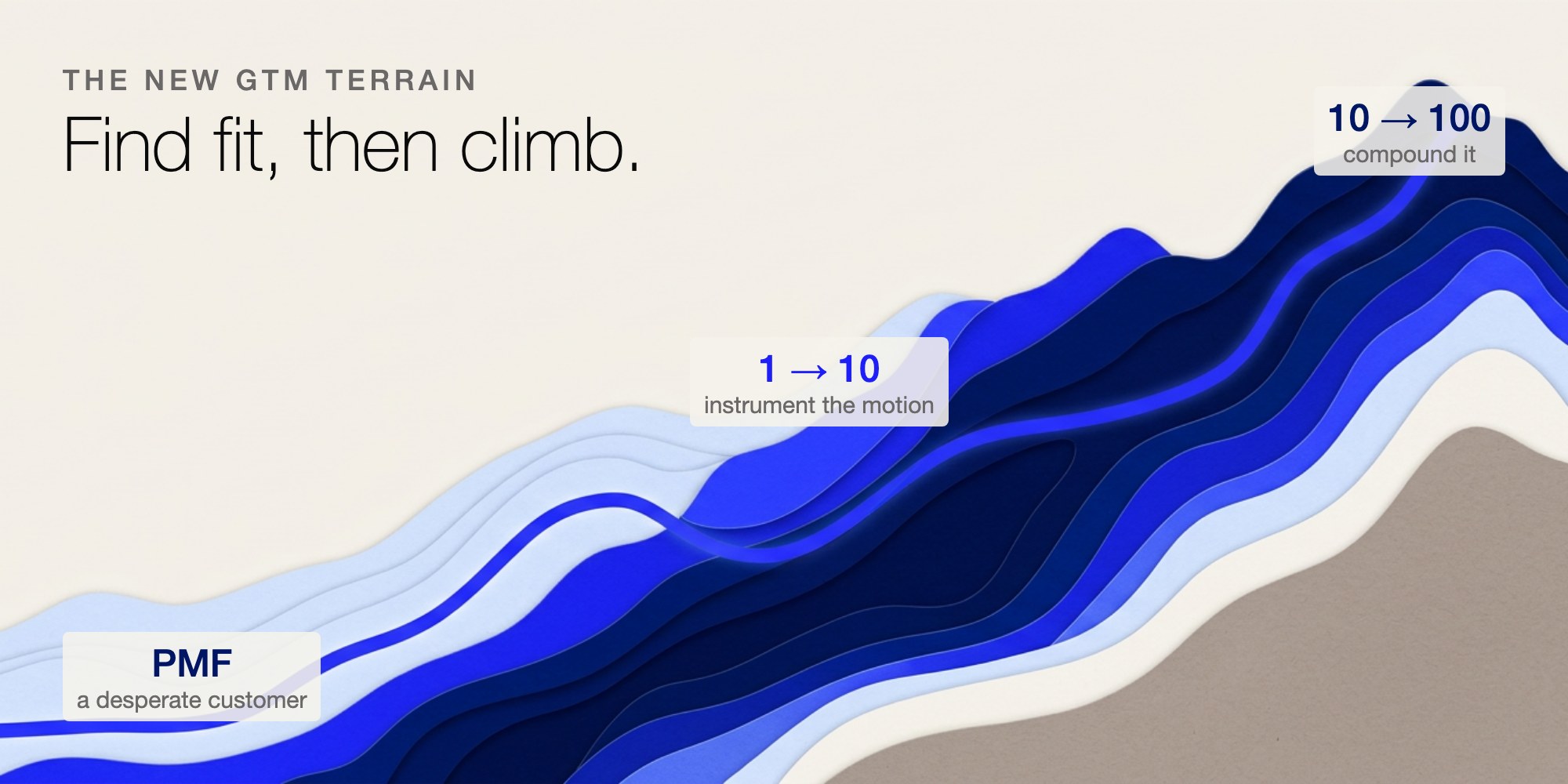
Find product-market fit, then climb. The foundations and the seven channels are waypoints on the same ascent — read the map, then the book.
Foreword

For more than two decades as a venture capitalist, I've watched the most successful enterprise founders scale their companies the same way, post product-market fit: add sales and marketing resources to create pipeline and close. There was a simple test for whether to keep going — sales yield. If the annual revenue a rep produced was greater than their fully loaded cost, you added another. We treated that ratio like proof of the product-market fit itself: the more value the product delivered, the higher the yield, the better the margins, the more efficient the growth. I've sat in thousands of board meetings that came down to exactly that math — how many reps, how fast they're ramping, what's their quota, what's their yield. That was the playbook, before AI. It's how the best enterprise companies scaled.
Now there are new physics. New guides. New tools. New rules. Enterprise buyers increasingly start, and sometimes finish, their evaluation by asking an agent instead of a human — Claude, GPT, Gemini, Copilot are doing the shortlisting, and in a growing number of cases, executing the decision. If you can't be found, understood, and selected by an agent, you're invisible to a real and growing share of your market before a human ever hears your name.
It's an exciting moment to build a company. It's also a chaotic one — the old rules don't fully apply, and the new ones are still being written in real time. My hope for this guide is that it brings some steadiness to that chaos: a clear-eyed look at what's actually changed, and what a founder can do about it this week, not just another reaction to the noise.
Unusual was built to help founders at every step of the journey. We've spent years specializing in the hardest part — finding product-market fit — and we've open-sourced what we've learned about that in our Field Guide. But finding fit was never the whole job, and right now the "what comes after" question is harder than it's been in a long time, because the old answer doesn't fully apply anymore.
That's the problem Jared Waxman has been working on solving, full-time, with our portfolio founders. He's spent his career in go-to-market, and for the last couple of years he's been in the trenches with our companies figuring out, concretely, what the best and newest tools and tactics actually are for growing after product-market fit in an AI-native world. This guide is his — his research, his frameworks, his read on where this is headed. I'm writing this foreword because I believe in the work and want more founders than just ours to have it, not because I wrote it.
We hope you get real, practical value out of it. And like everything we publish, we mean it when we say: tell us what worked, what didn't, and where we got it wrong. Go build.
— John Vrionis, Co-Founder & Managing Partner, Unusual Ventures
Start here: the 5-question diagnostic
This guide is just over 40 pages, about an hour's read. Answer five quick questions, one at a time, and it resolves to your wedge, your motion, your pricing shape, and the two or three channel chapters that actually matter for you right now.
The full channel logic, by wedge — for reference (your matching row is highlighted after you finish):
| If your wedge is… | Read these channels first |
|---|---|
| Self-serve-able · founder will post | Presence · Organic Social · Content (+ Inbound to convert the traffic) |
| Self-serve-able · founder won't post | Presence · Inbound · Paid Media (once the message resonates organically) |
| Trust-critical | Presence · Outbound · Field Events |
| Developer / agent buyer | Presence (GEO) · Build to Be Bought by an Agent · Content |
Contents
The book is two halves, written for two different jobs. Read the one that is yours first.
Part One is the strategy layer, and it is a founder's or an exec's problem. It starts from the change in who is doing the buying, increasingly an agent rather than a person, and follows that into the decisions only you can make: what your product has to make possible without a human in the loop, how you price and bill for it, what you hire for, and whether to build the motion or rebuild the one you already have. Eight chapters, meant to be read straight through.
Part Two is the execution layer, and it is the practitioner's problem. The same seven channels you already run, and what changed inside each one now that AI sits on both sides of the exchange. A reference, not a reading list. The diagnostic above named the two or three that matter for you.
Part One, The Core. read straight through
- Introduction, The New Physics of Go-to-Market
- How to Grow in the New Physics: 1→10 and 10→100 (the operating bridge)
- Pricing & Packaging: The Lever That Decouples Growth
- The Real 10→100 Engine: Expansion, Not Acquisition
- Build to Be Bought by an Agent
- Who You Hire, and When: The New-Physics Org
- Building vs Rebuilding: Two Very Different Starting Lines
- Company OS: The New GTM Playbook (the capstone)
Part Two, The Channel Reference. dip in by relevance
- How to use this reference
- The Seven Channels (Wave 1, executed well), Presence · Content · Organic Social · Inbound · Field Events · Outbound · Paid Media
- Forge Your Own Channel
Reference
- Appendix. Glossary · Tool Index · 90-Day Build Plan · Exemplar Quick-Reference
- About the Author