Outbound
Read this if: you run a trust-critical, named-account, sales-led motion. Skip if: your motion is pure self-serve and inbound-led.
The AI SDR that pitched me well enough to book the meeting — a fake LinkedIn profile with mutual connections, and an offer that never existed. Sending got free; trust didn't. What actually works now:
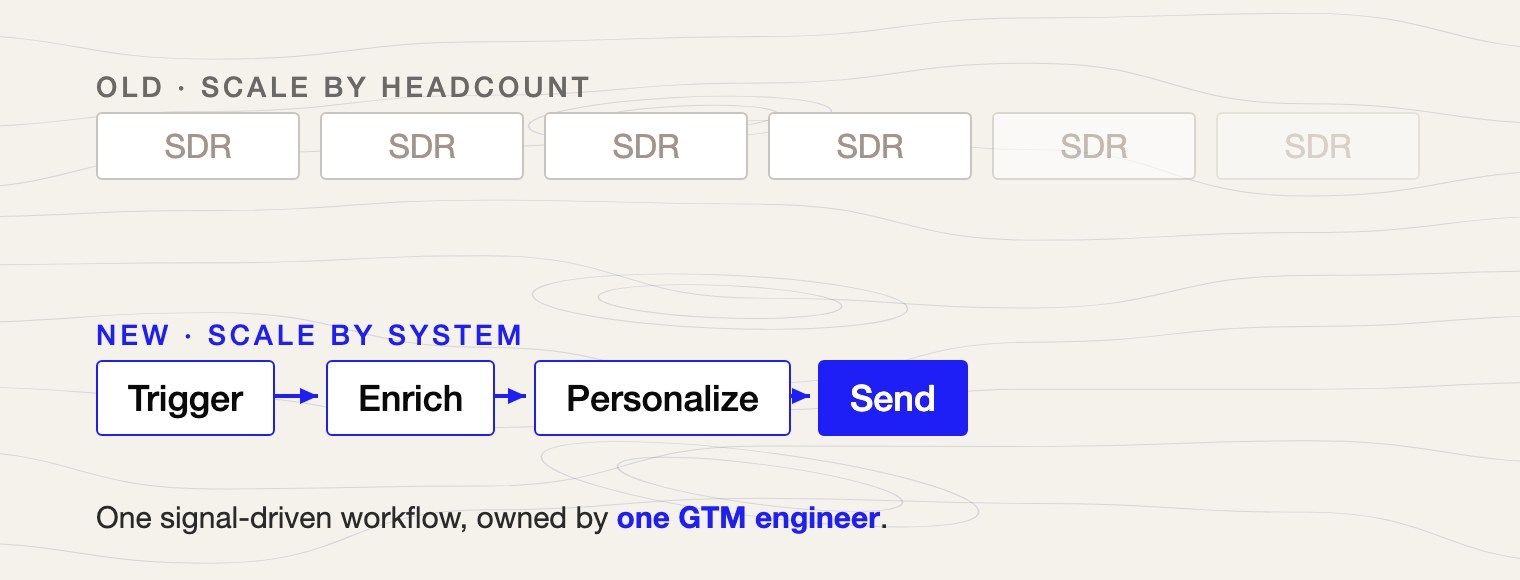
Watch the video ↗Outbound is where the new physics is most visible, and most misunderstood. The old answer to "more pipeline" was "more SDRs." In the new physics it's a signal-driven workflow owned by one GTM engineer where a team of reps used to sit. AI democratized the sending, which flooded every inbox and made human attention scarcer. The winners didn't send more; they built a system that waits for a real reason to reach out and then shows up dramatically better.
What's changed
Signals are cheap. Funding rounds, hiring patterns, tech-stack changes, exec moves, all queryable in minutes via Clay, Common Room, or Apollo. You no longer interrupt prospects cold; you wait until something gives them a reason to care.
Personalization is no longer a human bottleneck. A workflow reads a prospect's LinkedIn, their company's last earnings call, and three recent posts, and drafts a tailored opener in seconds. Which is also why personalization alone no longer impresses anyone: everyone has it.
The bottleneck moved to strategy. Picking the right signal, defining the trigger logic, designing the creative spine of the campaign. The doing is cheap; knowing what to do is the scarce skill.
Do this
- Pick one trigger and master it. Funded in the last 90 days. Posted a specific role. Lost their VP of Sales. Depth on one trigger beats breadth across twelve.
- Treat your enrichment workflow as your product. Version it, test it, improve it weekly. It belongs in your Company OS as a maintained play.
- Lead with a real reason to receive it. A relevant insight, a tailored teardown, an anchor asset worth opening. Aim for outreach so good the recipient would almost pay for it.
- Measure cost-per-meeting, not reply rate. Reply rate rewards noise.
Don't do this
- Don't buy an "AI SDR" hoping it replaces strategy. Every AI SDR that ships real pipeline runs on human-designed workflows. The vendor is selling you the wrapper. You still have to build the workflow.
- Don't ship shallow AI-personalized opens at scale. Recipients have now seen a thousand. Either commit to depth or stay generic and own it. The shallow middle is dead.
- Don't outsource your ICP to an LLM. Models will happily generate plausible-but-wrong target accounts.
In practice
Fal (an Unusual Ventures portfolio company) ran its earliest enterprise outbound the new-physics way: the founders personally closed the first major accounts (names like Amazon, Canva, and Netflix appear in its public story) before hiring a single rep; its first dedicated salesperson came in 2025. The point of founder-led outbound was to learn the motion a small, signal-driven team could later run.
Your first 30 days
- ☐ Write down your ICP yourself, and pick exactly one trigger you believe gives prospects a real reason to care.
- ☐ Build one enrich-draft-send workflow around that trigger, with one genuine anchor asset to lead with. Version it like a product.
- ☐ Switch your scoreboard to cost-per-meeting and meeting-to-opp. Run 30 days before you consider a second trigger.