Introduction: The New Physics of Go-to-Market
Why we made this guide, who it's for, and the one shift I'd want every founder to internalize before they read a single channel chapter.
Watch the video ↗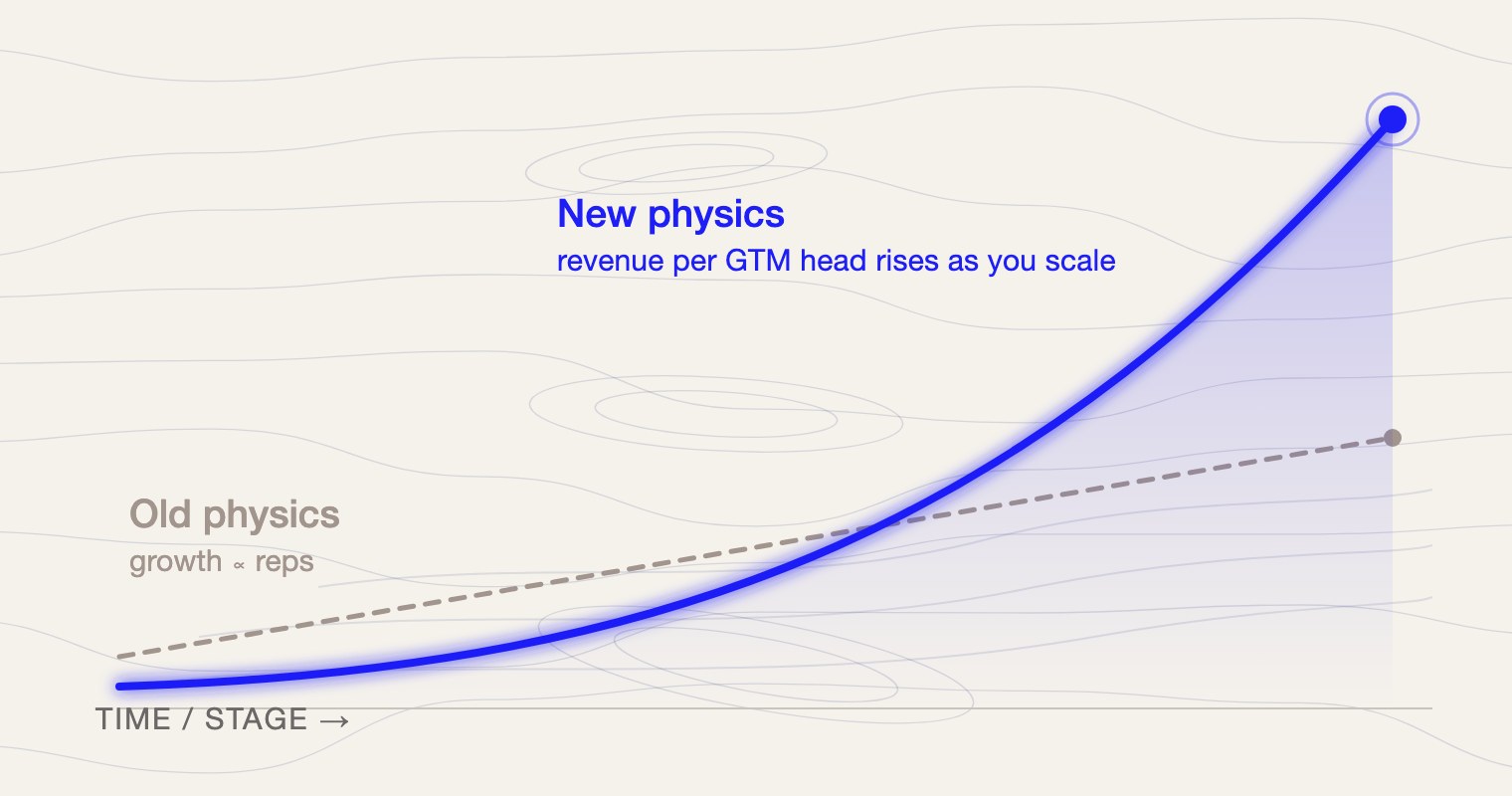
Every go-to-market motion still has the same job. Someone notices you exist, engages, and eventually becomes pipeline and then revenue. That arc hasn't changed. What changed is the physics underneath it.
For twenty years the atomic unit of growing an enterprise software company was the rep. Marketing filled a pipeline, sales hired and ramped against quota, and every growth plan I ever built came down to the same arithmetic: how much pipeline covers the number, and how fast new reps ramp. Need more revenue next year? Model more reps.
Growth has decoupled from headcount.
The thesis, in one sentence
In an AI-first world that formula is being rewritten, and the companies rewriting it grow on a slope the old playbook can't produce.
The version you've already heard
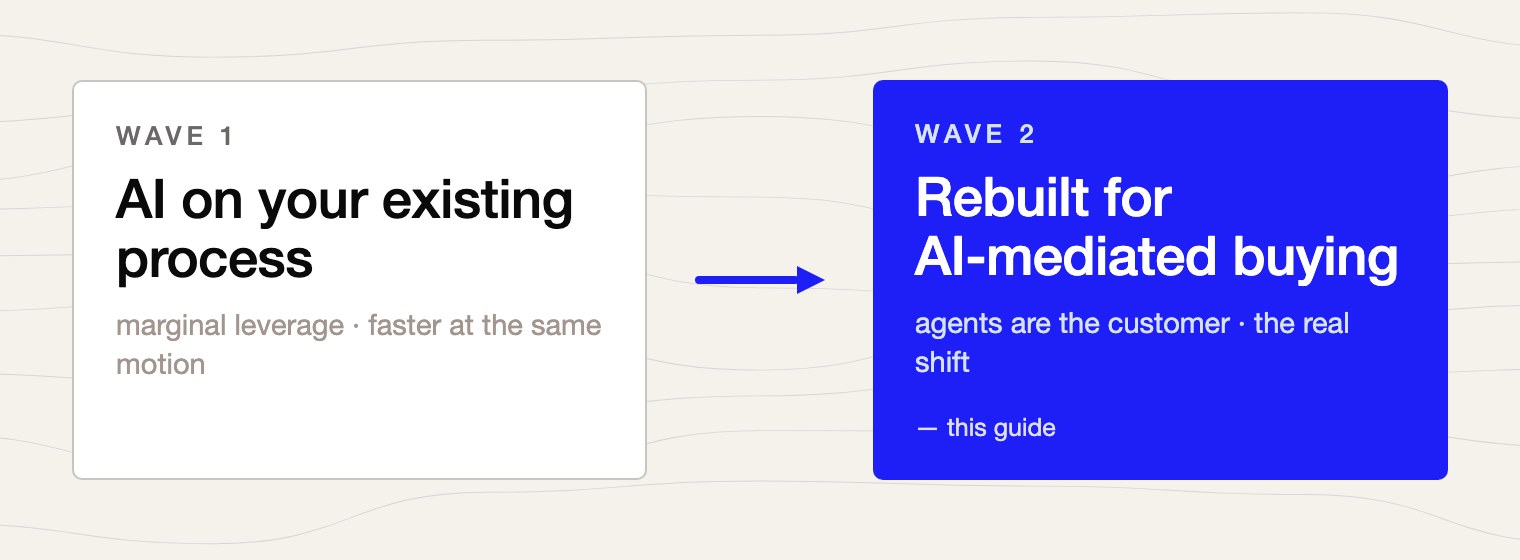
You've been told AI made go-to-market cheap: a quarter of content in a morning, outbound that personalizes itself, one person doing a team's work. All true, and all Wave 1: your existing process with AI applied to it. If AI just makes everyone faster at the same motion, having it stops being an advantage. Wave 2 is the real one: a go-to-market motion built from first principles for a world where the buyer is no longer only a human.
The new physics, in one sentence
Growth has decoupled from headcount.
A product that can be consumed and expanded without a human in the loop, distributed through channels that machines mediate, grows on a curve that has almost nothing to do with how many salespeople you hired. That's why GTM headcount predicts GTM success less every year.
Your buyer is now, increasingly, an agent
Buyers start by asking an AI. "What's the best tool for X?" gets answered by ChatGPT, Claude, or Perplexity, and you're in that answer or you don't exist. The agent shows up in three forms, and the playbook differs by which one you face:
- Agent as gatekeeper. A human delegates research to an assistant, so you must be visible and citable to the model. This is where almost every reader is today.
- Agent as consumer. An agent calls your product, having chosen it at runtime. That decision used to get made once, by a developer, and then sat hardcoded for years.
- Agent as buyer. The agent itself discovers, prices, and transacts. Railway already lets a coding agent sign up and deploy in one shot. Real, but early.
The middle one gets misread most. "Consumed programmatically and priced by usage" described Twilio in 2012; the change is when the vendor decision happens. Integration lock-in fades, because there is no integration to rip out, and what takes its place is being the default in the agent's context. Loyalty moves from the integration to the shortlist, and shortlists are winner-take-most. Two things follow: an account that never churns can route 90% less traffic to you next month with no renewal conversation to warn you, and the gap between shipping a feature and agents knowing it exists becomes worth managing. That last one is the real argument for an MCP server.
Nobody can size this yet, us included. A request carries no record of who decided to send it, so a cron job written in 2024 and an agent ninety seconds old arrive on the same API key. What the data shows is how early it is: in Postman's 2025 survey of more than 5,700 developers, 24% design APIs with agents in mind against 60% still designing for humans only, and half named excessive agent API calls as their top security worry (State of the API ↗). You don't rank a threat first unless you're watching it happen.
The precise version
"You won't need reps" is directionally true and literally misleading. Three claims hold up:
- Reps don't vanish; they become engineers. Companies living the new physics still add people, just not quota-carrying AEs. Growth decouples from the rate of sales hiring, and revenue per head rises.
- Your wedge dictates your motion. A self-serve-able wedge gets a low-rep, product-led motion. A trust-critical wedge (regulated, deep integration, committee buyer) gets a forward-deployed sales motion, and that's the correct call.
- The zero-rep extreme depends on product shape. Committee buyers keep humans, but the revenue-to-headcount ratio should still climb.
One guardrail
All of this assumes you already have product-market fit. PMF is the value hypothesis. Go-to-market is the growth hypothesis, and it comes only after you've earned fit.
How to read this book
Read the Core (the next seven chapters) straight through. Treat the Channel Reference as a menu: the diagnostic at the front named the two or three channels that matter for your motion.
The single biggest mistake I see founders make when they first adopt AI for GTM — mistaking the speed for the strategy — and the one habit that separates the teams pulling ahead.
Watch the video ↗