Pricing & Packaging: The Lever That Decouples Growth
The pricing mistake I see most often in AI-native companies — charging for the worker when you should charge for the work — and the one question that tells you if your pricing is doing the decoupling for you.
Watch the video ↗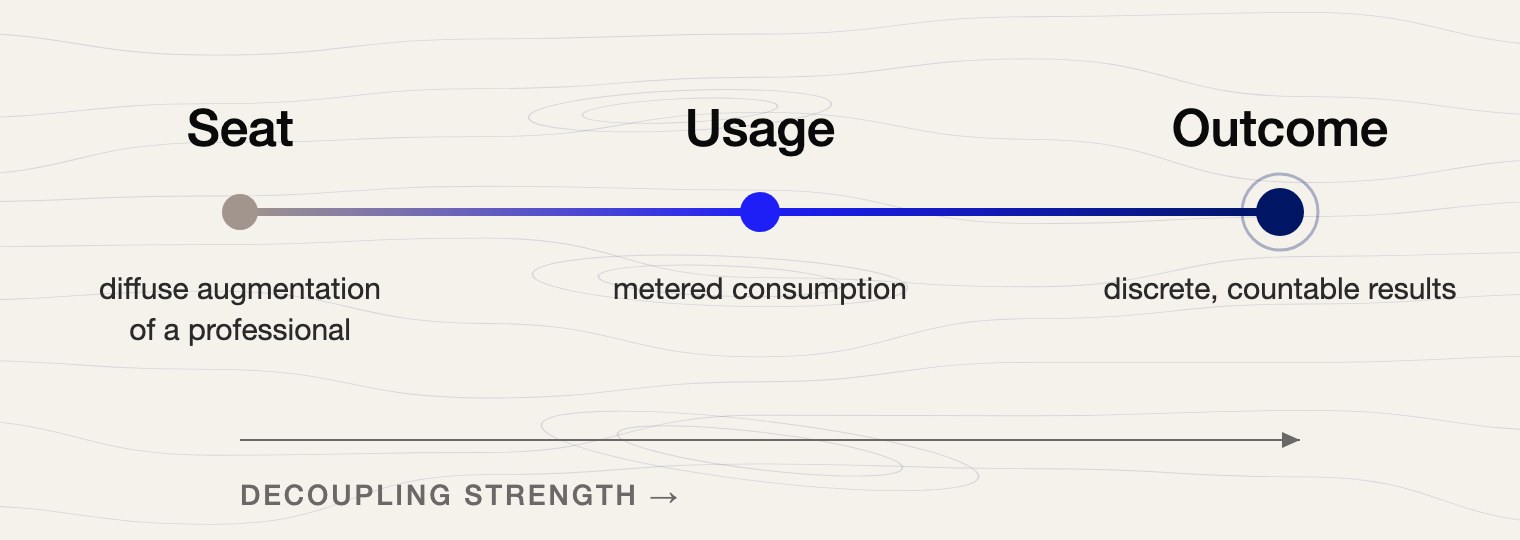
If the new physics has a single most important lever, it's this one. Pricing is the mechanism by which revenue grows without a human selling. Get it right and expansion happens on its own: usage climbs, the bill climbs, nobody renegotiated. Get it wrong and every dollar of expansion needs a rep to go capture it.
Charge for the work, not the worker
The seat made sense when the human did the work. It is actively wrong when the AI does the work, because the better your product gets, the fewer humans your customer needs, so you charge less exactly as you deliver more value. Bret Taylor of Sierra: "the atomic unit of productivity in AI is a process, not a person." Sierra charges per resolved case; if it escalates to a human, that's free (Cheeky Pint ↗).
The atomic unit of productivity in AI is a process, not a person.
Bret Taylor, Sierra · source ↗
Three shapes
- Outcome pricing. For discrete, measurable results (a resolved ticket, a completed task). Sierra, Decagon. The purest decoupling.
- Usage pricing. For metered consumption (an inference, a compute-second, a generated character). Fal, Modal, Railway, ElevenLabs.
- Seat pricing. Still right for diffuse augmentation of a high-value professional, where you can't cleanly meter the output. Harvey and Glean are seat-based for this reason, and both are drifting toward usage. Know what you're betting on: a seat model is a bet on your customer's headcount, and AI is shrinking headcounts everywhere. If your buyer shrinks the team, your revenue shrinks while the value you deliver doesn't move.
The decision rule: if your product produces something countable, price the count. A good value metric scales with the customer's success rather than their headcount, is predictable enough to budget, and is hard to game and easy to audit.
“Right now it’s mostly seats, but we’re moving to more outcome-based pricing as the workflows get more complex.”
— Winston Weinberg, CEO, Harvey · source ↗
The traps
- "What is a resolution?" Decagon's Jesse Zhang ran straight into it (a16z ↗). If you can't define the outcome in a sentence both sides accept, price the input instead.
- Bill shock. A surprise invoice churns customers faster than a high price ever did. Offer caps, alerts, and committed-use tiers.
- Margin coupling. If you resell tokens or compute, your COGS rides up with revenue. Know your unit economics at the metered level.
- The free-tier leak. A free tier is a marketing channel. Generous enough to reach real value, gated enough to convert.
Packaging
The entry tier is the wedge: self-serve, fast to value, no "talk to sales" wall. Land small and expand on consumption. Add "talk to sales" only at the top, where committed contracts and procurement genuinely need a human. A free tier and enterprise sales coexist: Cursor and ElevenLabs run both.
If you're re-pricing an existing base, don't flip it at once. Grandfather existing contracts, offer a hybrid (a seat floor plus usage), migrate at renewal, and lead with "pay for what works."
The test
Does your revenue grow when your customer succeeds, without a human renegotiating? If no, you've re-coupled growth to headcount, and no amount of channel work downstream will fix it.
Your first 30 days
- ☐ Write the value your product delivers in one sentence, then find the metric that scales with it.
- ☐ If you sell outcomes, define the outcome in a sentence a customer would accept, or fall back to the input unit.
- ☐ Add caps, budgets, and alerts before you ship usage pricing.