Building vs Rebuilding: Two Very Different Starting Lines
The hardest version of this isn't the founder starting fresh — it's the team with a working 2019 motion who has to tear it up. Why the rebuild is scarier than the build, and how to do it without blowing up the business you already have.
Watch the video ↗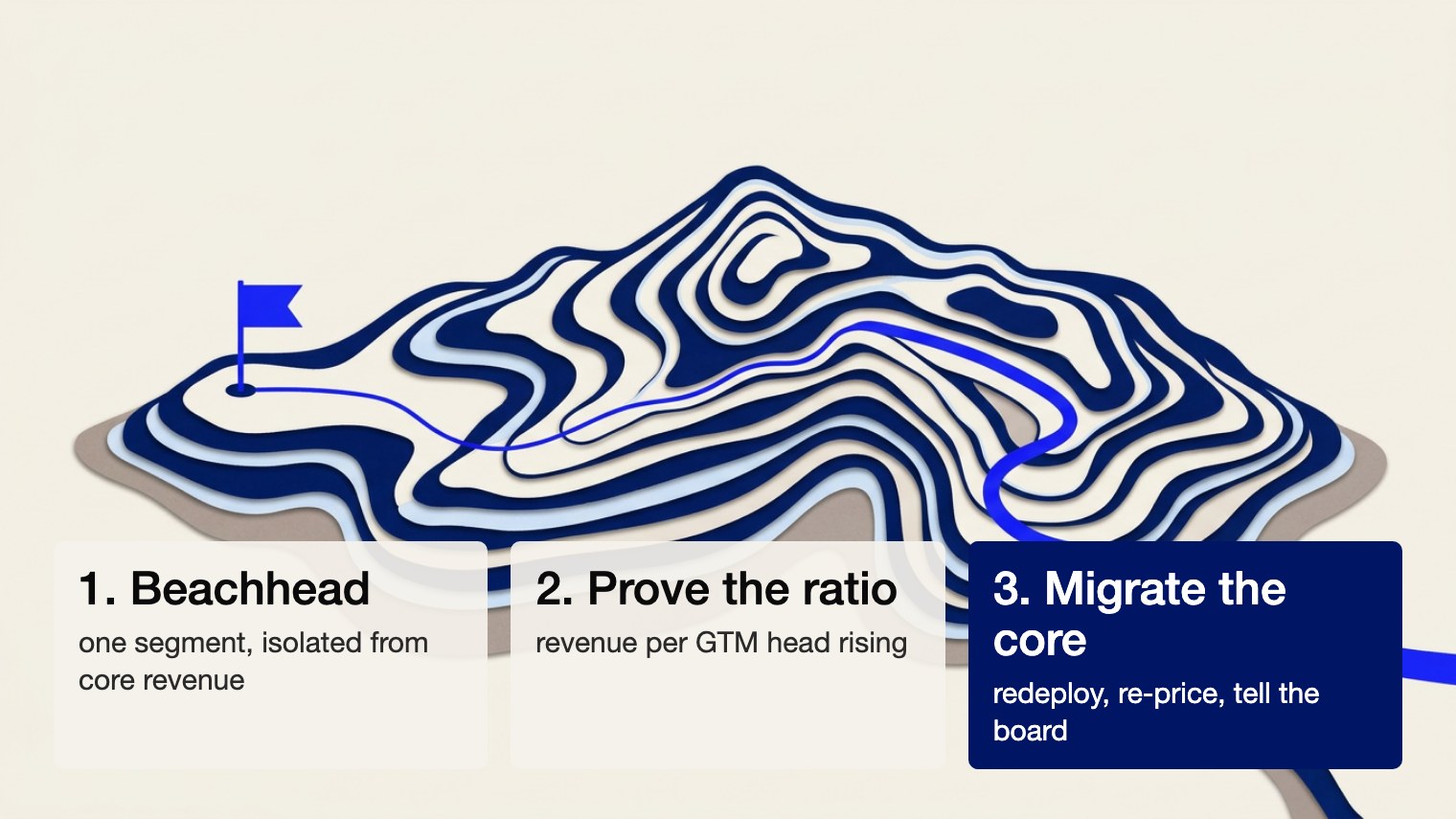
This guide is written for two kinds of founder: the one building a go-to-market motion from scratch, and the one rebuilding a motion that already works. The second job is harder. A working motion has momentum, and the brave move is to go back to the drawing board anyway.
If you're building from scratch
Your advantage is no legacy: no sales team defending its quota, no installed base on seat pricing, no CRM full of old process. The risk is that you rebuild the old playbook out of habit. The three greenfield mistakes: hiring a sales team before the product can sell itself, skipping to scaling before PMF, and copying the org chart from your last company.
If you're rebuilding
You're performing surgery on a running business. The challenge is unlearning the old motion without breaking the business that's paying the bills.
- Inertia and politics. The existing GTM org will, rationally, defend the model that justifies its headcount and comp. Manage it as self-interest.
- Re-pricing the installed base. Grandfather, hybrid, migrate at renewal (the pricing chapter).
- Redeploying the team. Your best reps can often become excellent forward-deployed engineers or solutions sellers. Not all will make the jump.
- Cannibalization fear. A self-serve tier looks, to your sales org, like it undercuts their ACV. Reframe it: self-serve is the funnel that feeds the expansion motion.
- The board narrative. The AI-native growth slope is what's commanding the best valuations; frame the rebuild as the path onto it.
The migration playbook
Don't rip everything out at once. Run the new motion as a beachhead inside your own company, prove it, then expand:
“We learned that through basically getting punched in the face over and over.”
— Scott Stephenson, co-founder & CEO, Deepgram — on going sales-first before PLG · source ↗
- Pick a beachhead. One segment, product line, or SKU you can run new-physics-native, isolated from core revenue.
- Instrument it. Activation, usage expansion, % no-touch revenue, revenue-per-head.
- Build the motion there. Self-serve entry, usage pricing, agent-buyable front door, founder-led on the few big accounts.
- Prove the ratio. Rising revenue-per-GTM-head in the beachhead is your evidence for everyone who'll resist.
- Redeploy the team and re-price deliberately.
- Tell the board the slope story early, with the beachhead data.
- Expand outward once the beachhead proves the motion.
Should you rebuild now?
You rebuild when the old motion is visibly breaking: growth flattening while AI-native competitors post steeper curves, CAC rising as added reps stop adding pipeline, buyers arriving having researched you through an assistant, your best new revenue coming from product usage rather than the sales motion you keep funding. If two or more are true, the rebuild is the safer bet and standing still is the gamble.
The test
Builders: are you adding humans before the product can sell itself? Stop. Rebuilders: can you point to a beachhead where the new motion is proven before you migrate the core? If not, build that first.